Enjoy exclusive discounts on courses!

5 BEST EXFOLIATING INGREDIENTS IN CLEANSER THAT ACTUALLY WORK FOR ACNE, DARKSPOTS AND WRINKLES
If you’ve been searching for the best exfoliating cleanser ingredients for acne-prone or oily skin, this guide breaks it down in a clear, practical way. We explore 5 exfoliating ingredients that can actually work in a cleanser—including AHAs, BHAs, and PHAs like salicylic acid, glycolic acid, gluconolactone and mandelic acid. You’ll learn how these ingredients help unclog pores, reduce breakouts, fade dark spots, and improve uneven skin texture—even in a wash-off product. From a formulation perspective, it’s not just about having the right ingredient on the label, but how it’s used within the cleanser. Many products contain these actives but still fail to deliver real results. If you’ve tried different face cleansers without seeing improvement, this article will help you understand what to look for and how to choose a cleanser that actually supports clearer, healthier skin over time.
Dr Kathryn
4/27/20263 min read
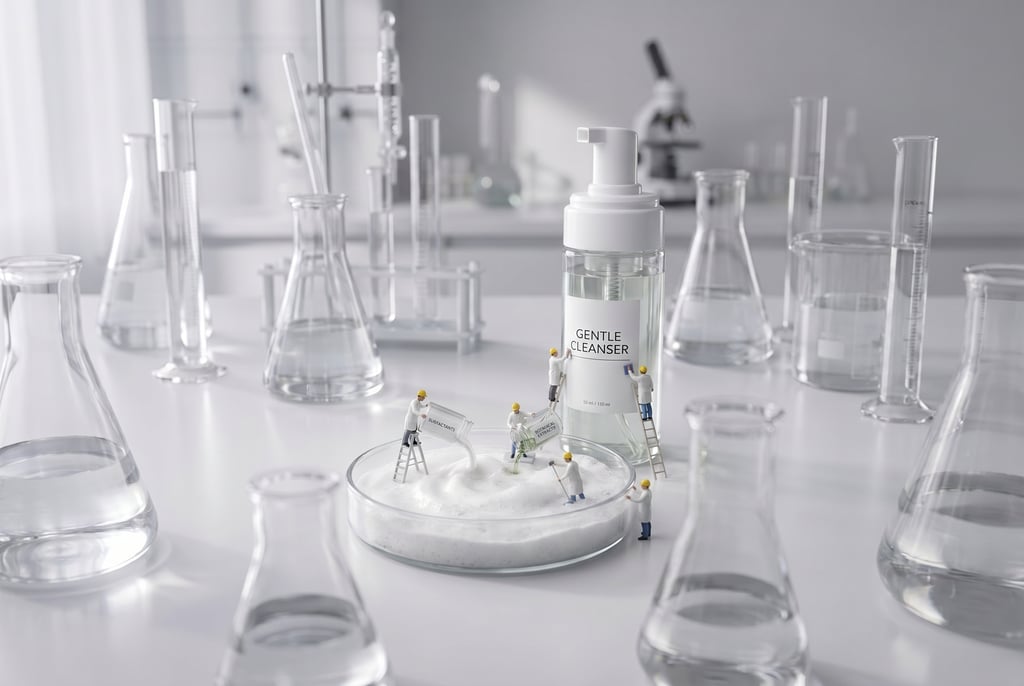
TOP 5 CLEANSER EXFOLIANTS THAT ACTUALLY WORK
Let us breakdown the few ingredients in a cleanser that can still deliver results even though it is a wash-off product.
SALICYLIC ACID
Naturally found in the willow bark tree. If you have acne, oily skin, whiteheads, blackheads, razor-bumps, look out for this ingredient. Salicylic acid is a BHA (beta-hydroxy acid), it is oil-soluble therefore able to penetrate deep into your skin pores to:
Unclog pores
Breakdown excess oil
Reduce inflammation
Smoothen the skin
Here is the part most people do not realise, even in a cleanser which is used for a few minutes and washed off, salicylic acid mixes with the skin's oils to effectively deliver its effects.
Unfortunately if Salicylic acid is not incorporated well in the formula, it loses it's effectiveness. We’ll break this down in detail in our next article: “Why Most Cleansers Don’t Actually Work"
GLYCOLIC ACID
Glycolic acid is known for one thing: Smooth, bright, youthful skin!
It is an AHA (alpha hydroxy acid) naturally found in sugarcane and beets. It works by loosening bonds between dead cells helping the skin shed off dead cells faster. Glycolic acid is able to work fat on the skin even with a short contact time.
Glycolic acid is perfect for:
Dull skin
Skin with uneven texture
Early signs of darkspots
Early signs of lines and wrinkles
Sadly, most glycolic cleansers are either too harsh or too little in the formula to cause any visible changes.
The main issue is not the ingredient but how it is formulated.
LACTIC ACID- GENTLE MULTI-TASKER
Cleopatra's secret of beauty, naturally found in milk. It is reported this Queen of Sheba soaked herself in milk for a glass skin glow.
Lactic acid is an AHA, it is a mild exfoliant yet also hydrates the skin meaning you get exfoliation without the tight and dry skin feel some exfoliants give.
Lactic acid is ideal for:
Sensitive skin
Dry skin
It's hidden advantage is that it exfoliates without drying the skin helping maintain the skin barrier. This is what most acne cleansers" ignore.
MANDELIC ACID -THE UNDERRATED DARKSPOT SOLUTION FOR DARKSPOTS
This exfoliant does not get enough attention as it should.
It has a large molecular structure, which means it will not penetrate deep into the skin but will work slowly on the skin surface. This is great for:
Sensitive skin
Melanin-rich skin
Acne-prone skin
If you are dealing with:
Dark-spots
Acne break-outs on sensitive skin
Uneven skin tone
This is one of the safest, fast working exfoliants to look for in a cleanser.
Yet most brands overlook it.
GLUCOLONOLACTONE-THE BARRIER-FRIENDLY EXFOLIANT
Inspired by most Korean skin care with the allure of "glass skin glow". this gentle exfoliant is the latest innovation in Cleanser formulation.
Gluconolactone is a PHA( poly hydroxy acid) that is:
Extremely gentle
Hydrating
Skin-barrier protective
It does not aggressively remove dead skin cells but gradually improves skin texture whilst hydrating the skin.
It is perfect for:
Sensitive skin
Beginners in exfoliation
Barrier repair routines
This is how an exfoliating cleanser is formulated without damaging the skin.
Well, you maybe thinking, "Okay.....I need a cleanser with all these exfoliant ingredients"
Not quite.
An ingredient alone does not whether a cleanser works. What actually matters is:
The formulation process
The pH level
The surfactant blend
The contact time
The skin needs
In fact, 2 cleansers with the same ingredients can give completely different results.
So, why do most cleansers fail?
Because most are designed for:
Marketing claims
Abundant foam
Fragrance experience
Not:
Skin barrier protection
Ingredient performance
Long term skin health
No wonder consumers keep switching products but still do not get real results. Instead of spending years trying different cleansers, always wondering what should you buy?Best to start asking, how does this cleanser work? This is where real control begins.
ABOUT THE AUTHOR
Dr. Kathryn Limo is a cosmetic scientist and medical doctor specializing in cosmetic formulation, manufacturing, and regulatory compliance. She has led cosmetic R&D across multiple product categories, formulating over 50 cosmetic products and contributing to more than 15,000 formulations. Her expertise spans ingredient science, product development, and creating effective, market-ready products.
Dr Kathryn has successfully secured FDA registrations and manufacturing approvals, implemented Good Manufacturing Practices (GMP), quality systems, and operational standards to ensure consistent product quality. She has also played a key role in setting up production processes and supporting brands through regulatory requirements.
Through her consulting work, she supports innovation within the cosmetics industry, helping businesses develop safe, high-quality products. As the founder of Inside Cosmetics, Dr Kay is passionate about educating and empowering aspiring formulators with practical, science-based knowledge.